

How a Gold IRA Works
Gold IRAs have attracted over $30 billion in estimated assets under custody across self-directed IRA providers, yet most investors open their account without fully understanding the mechanics. Skipping a single step, or misunderstanding who is responsible for what, can trigger unexpected taxes, penalties, or fees that erode your savings. Below you will learn the five steps to set up a Gold IRA, how the four parties involved divide their responsibilities, and the mistakes that trip up most first-time investors.
Key Takeaways
- A Gold IRA holds physical metals inside a tax-advantaged retirement account.
- Five steps connect custodian selection to storage and eventual distribution.
- Every step involves a different party, so understanding roles prevents costly mistakes.
What Is a Gold IRA?
A Gold IRA is a self-directed individual retirement account that holds physical precious metals instead of stocks, bonds, or mutual funds. A specialized custodian administers the account. An IRS-approved depository stores the metals on your behalf (Source: 26 U.S. Code § 408).
Gold IRAs follow the same contribution limits and tax rules as traditional or Roth IRAs, as outlined in IRS Publication 590-A. The key difference is what you hold inside the account. Instead of paper assets, your retirement savings sit in tangible gold, silver, platinum, or palladium that meets IRS purity standards.
Since 2024, our team has researched more than 15 Gold IRA providers and analyzed their fee structures, custodian arrangements, and storage options to help readers make informed decisions.
How does the five-link Gold IRA process work?
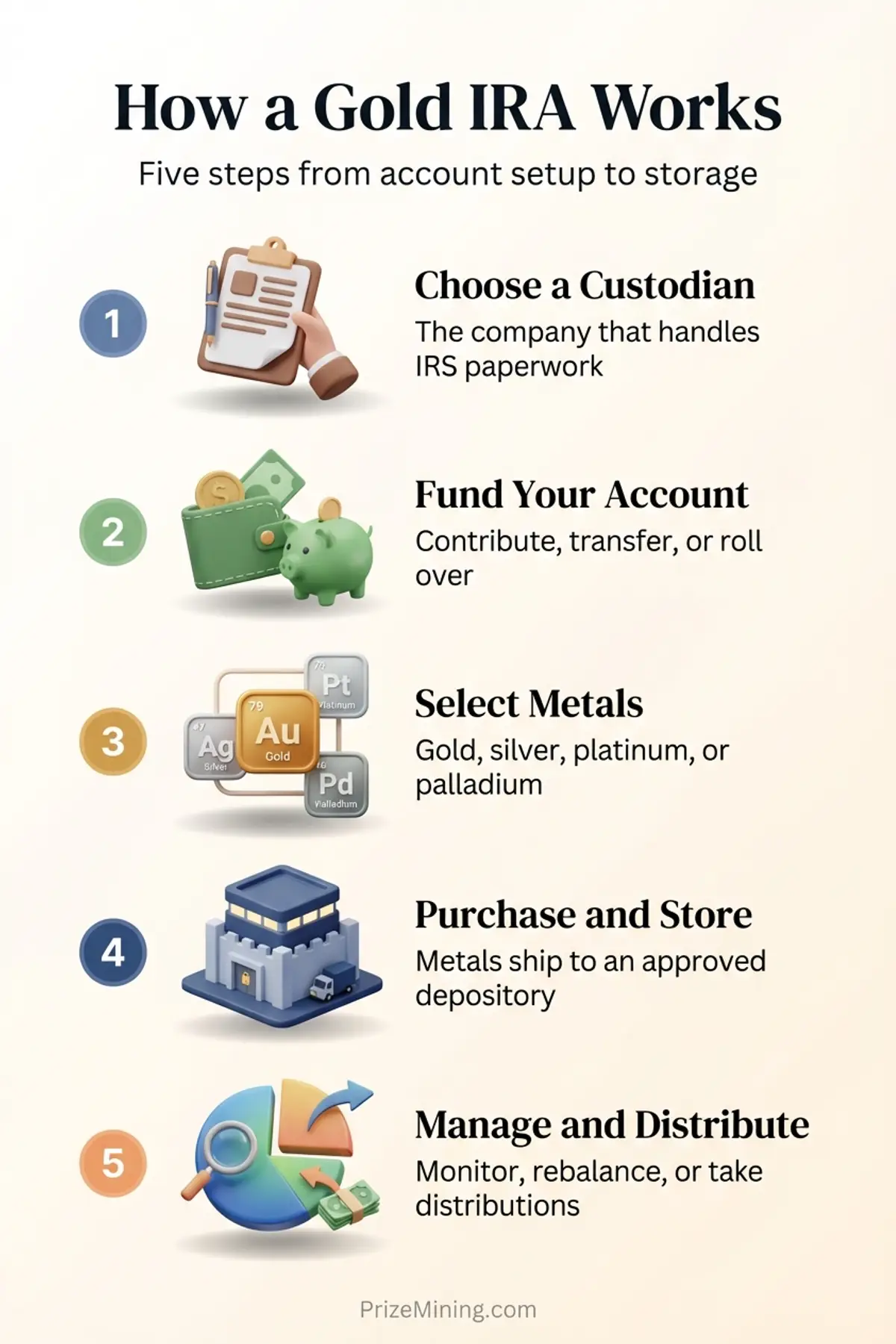
Opening a Gold IRA involves five connected steps in this order: choose a custodian, fund the account (rollover or contribution), select IRS-approved metals, arrange depository storage, and plan distribution timing. Each step has a different cost and a different timeline. A weakness in any single step — wrong custodian, wrong metals, hidden fees, poor storage, no exit plan — undermines the entire account.
Each link depends on the one before it. Rushing through one step often causes problems later. Below is a walkthrough of all five.
Step 1: Choose a Self-Directed IRA Custodian
A custodian — the financial institution that holds your account paperwork and reports to the IRS — is required by federal law under IRC § 408(a). The custodian handles paperwork, files the annual Form 5498, and processes contributions and distributions. Regular brokerages like Fidelity or Schwab do not offer Gold IRAs. You need a custodian that specializes in self-directed accounts and allows physical metals. Gold IRAs are a type of self-directed IRA, which allows investments beyond stocks and bonds.
Look for a custodian with a clean regulatory record, transparent annual fees, and a clear explanation of how they work with dealers and depositories. The Better Business Bureau and state licensing databases can help you verify their standing. The SEC's investor alert on self-directed IRAs outlines additional due diligence steps.
Not all custodians charge the same fees or work with the same depositories. When we first compared providers in 2024, we focused mainly on setup fees. After tracking total costs over 12 months, annual maintenance and storage fees turned out to be the larger expense for most investors. Comparing at least three providers before deciding can save hundreds of dollars per year. We explain how we evaluate providers on our review methodology page.
Step 2: Fund Your Account
Once your custodian account is open, you need money in it before you can buy metals. Gold IRAs can be funded in three ways: a direct contribution, a transfer from an existing IRA, or a rollover from a 401(k) or other qualified plan.
Direct contributions follow the same annual limits as any IRA. For 2026, the limit is $7,000 ($8,000 if you are 50 or older). Transfers and rollovers can move larger sums because the money already sits in a retirement account (Source: IRS Publication 590-A).
Rollovers require careful timing. A direct rollover moves funds from one custodian to another without passing through your hands — no withholding applies and no 60-day clock starts. An indirect rollover sends funds to you, and you have 60 days to deposit them into the new account. Missing that deadline triggers ordinary income tax on the full amount plus a 10% early-withdrawal penalty if you are under 59½. The direct path avoids both risks (Source: IRS Publication 590-A).
If you plan to move funds from an existing retirement plan, our Gold IRA rollover walkthrough covers the process and common pitfalls in detail.
Step 3: Select Your Metals
Not every gold product qualifies for an IRA. The IRS requires specific purity levels: gold must be at least 99.5% pure, silver at least 99.9%, and platinum or palladium at least 99.95%. Certain coins, like the American Gold Eagle, receive a specific exemption despite not meeting the general purity threshold (Source: 26 U.S. Code § 408).
Your dealer, the company that sells you the metals, should clearly label which products are IRA-eligible and which are not. Some dealers steer customers toward high-markup collectible coins that do not qualify. Ask for IRA-eligible options only and confirm eligibility before purchasing.
We maintain a list of IRA-eligible metals with purity requirements and common qualifying products for each metal type.
Step 4: Purchase and Ship to an Approved Depository
After you select your metals, the custodian directs the dealer to ship them to an IRS-approved depository. You do not take physical possession. Storing Gold IRA metals at home violates IRS rules and can trigger the full value as a taxable distribution (Source: IRS Publication 590-B).
The depository is an IRS-approved vault facility that holds your metals while you own them. Depositories offer two storage types. Commingled storage pools your metals with other investors' holdings. Segregated storage keeps your exact coins or bars separate. Segregated storage costs $50–$150 more per year and guarantees you receive the same items you bought when you take an in-kind distribution.
Established depositories like Delaware Depository and Brink's carry Lloyd's of London insurance on stored metals. Verify insurance coverage before your metals ship. Your custodian can confirm which depository they use and what insurance applies.
Step 5: Manage, Monitor, and Eventually Distribute
Once your metals are in storage, your Gold IRA functions like any other IRA for tax purposes. You can add to it annually, rebalance between metals, or let it sit. Your custodian sends yearly statements and handles required IRS reporting.
When you reach age 59 and a half, you can take distributions without penalty. You have two options: receive the physical metals shipped to your home, or have the custodian sell the metals and send you cash. Traditional Gold IRA distributions are taxed as ordinary income. Roth Gold IRA distributions may be tax-free if the account meets holding requirements (Source: IRS Publication 590-B).
Required minimum distributions (RMDs) apply to traditional Gold IRAs starting at age 73. Because metals are not as liquid as stocks, plan your RMD strategy well in advance. Selling metals takes longer than selling shares, and the spread between buy and sell prices can eat into your distribution amount.
Who handles what in a Gold IRA?
Four parties handle a Gold IRA, each with a distinct legal role: you (account holder, makes investment decisions), the custodian (financial institution that administers the account and reports to the IRS), the dealer (sells you the metals), and the depository (stores the metal under IRS rules). Confusing these roles is the most common source of frustration for new investors. The table below clarifies who is responsible for what.
| Task | You | Custodian | Dealer | Depository |
|---|---|---|---|---|
| Choose a provider | ✓ | |||
| Open the IRA account | ✓ | ✓ | ||
| Fund the account | ✓ | ✓ | ||
| Select metals | ✓ | ✓ | ||
| Execute the purchase | ✓ | ✓ | ||
| Ship metals to storage | ✓ | ✓ | ||
| Store and insure metals | ✓ | |||
| IRS reporting | ✓ | |||
| Process distributions | ✓ | ✓ | ✓ |
Your primary relationship is with the custodian. The custodian coordinates with dealers and depositories on your behalf. However, you remain responsible for choosing which metals to buy and deciding when to take distributions.
How long does each step take?
Most investors complete the process in one to three weeks. The funding step usually takes the longest, especially if you are rolling over a 401(k) from a former employer.
| Step | Typical Timeline | What Can Delay It |
|---|---|---|
| Choose a custodian | 1 – 5 days | Comparing multiple providers, waiting for fee disclosures |
| Fund the account | 3 – 10 business days | 401(k) administrator delays, indirect rollover processing, wire transfer holds |
| Select metals | 1 – 2 days | Waiting for dealer pricing, verifying IRA eligibility |
| Purchase and ship | 5 – 10 business days | Product availability, depository intake processing, insured shipping schedules |
| Ongoing storage | Continuous | N/A (annual fees billed by custodian and depository) |
Ask your custodian for an estimated timeline before you start. Knowing the expected schedule helps you spot delays early and follow up with the right party.
How does a Gold IRA differ from buying coins directly?
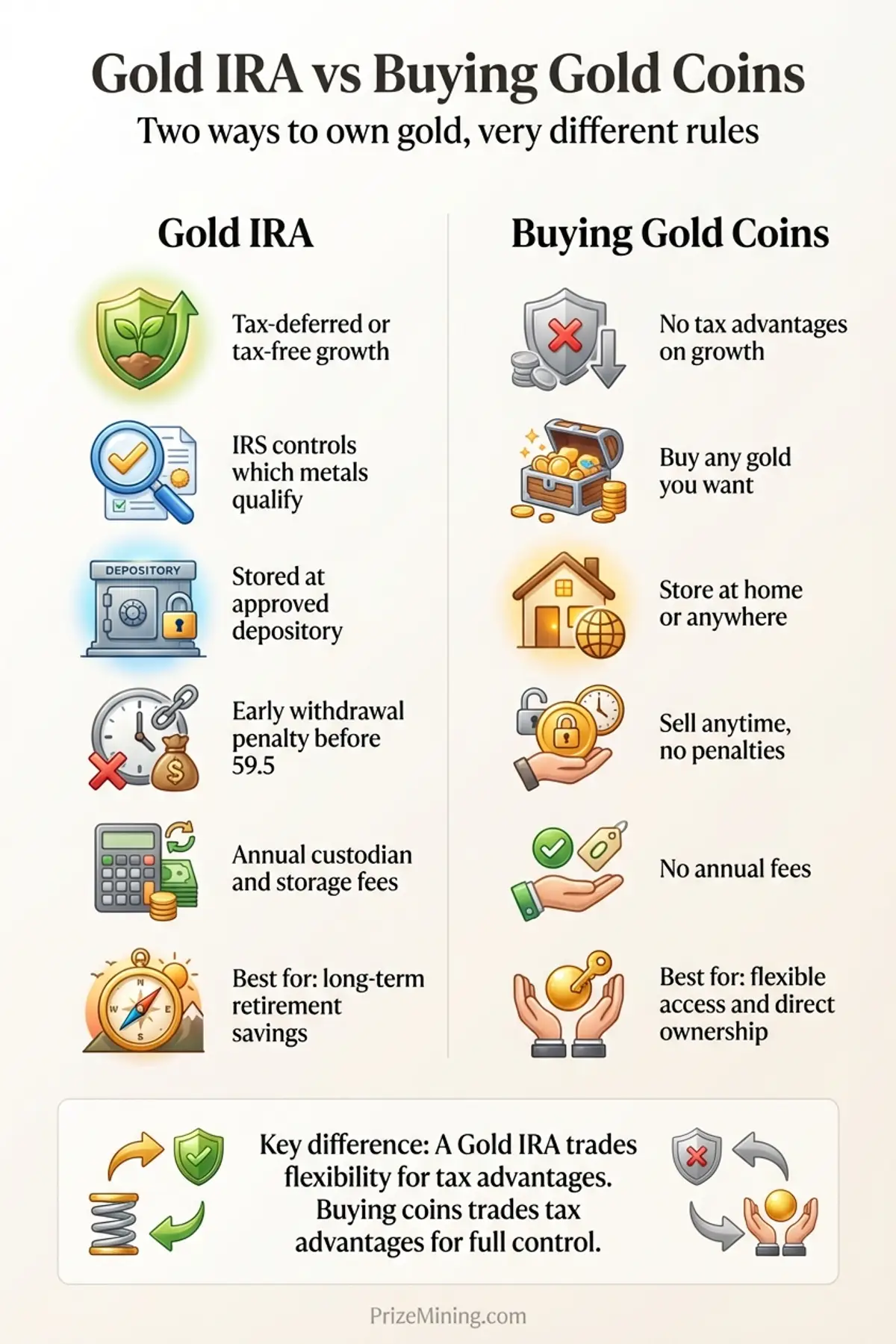
A Gold IRA differs from buying coins directly in three concrete ways: tax treatment (Gold IRA grows tax-deferred or tax-free in Roth; direct ownership is taxable on capital gains), storage requirement (Gold IRA must use an IRS-approved depository; direct ownership has no requirement), and access (Gold IRA cannot be physically held by you while inside the account; direct ownership can). Each difference has a different financial consequence detailed below.
When you buy gold coins outright, you own them directly. You can hold them at home, sell them at any time, and pay capital gains tax when you sell at a profit. No custodian is needed. No IRS rules dictate which coins you can buy or where you must store them.
A Gold IRA wraps the metals inside a retirement account. The tax advantages are significant: growth is tax-deferred (traditional) or potentially tax-free (Roth). However, you give up direct access. IRS rules control which metals qualify, where they are stored, and when you can take distributions without penalty. Early withdrawals before age 59 and a half typically trigger a 10% penalty plus income tax.
Neither option is universally better. Buying coins outright makes sense if you want immediate access and flexibility. A precious metals IRA works better if your goal is long-term retirement savings with tax advantages.
What are common mistakes when opening a Gold IRA?
Five common mistakes cost investors money or create tax problems when opening a Gold IRA: choosing a custodian based only on the lowest setup fee (ignores 4 of 5 fee layers), accepting the dealer's first metal recommendation without checking IRS eligibility, requesting an indirect rollover when a direct rollover would avoid withholding, taking physical possession of metals from the IRA (deemed distribution + 10% penalty if under 59½), and skipping the written fee schedule. Each is detailed below.
Picking a custodian based on the lowest setup fee alone
A low setup fee may come with high annual fees, expensive storage, or limited depository options. Total cost over five or ten years matters more than the upfront charge. Compare the full fee schedule before committing.
We break down all the common cost categories in our Gold IRA fees overview.
Missing the 60-day indirect rollover deadline
If you choose an indirect rollover and fail to deposit the funds within 60 days, the IRS treats the entire amount as a taxable distribution. For someone in the 24% tax bracket with a $50,000 rollover, that mistake could cost $12,000 in taxes plus a $5,000 early withdrawal penalty. A direct rollover removes this risk completely.
Buying non-eligible metals
Some dealers sell collectible or rare coins that do not meet IRS purity requirements. Placing non-eligible metals in an IRA can trigger the full amount as a taxable distribution. Always confirm IRA eligibility before finalizing a purchase.
Storing metals at home
Despite claims from some companies, storing Gold IRA metals in a home safe or a personal safe deposit box violates IRS rules. The IRS considers home storage a distribution, which means taxes and penalties. Only IRS-approved depositories qualify (Source: IRS Publication 590-B).
Ignoring the exit strategy
Gold is not as liquid as stocks. Selling metals takes time, and the buyback spread, the gap between what you paid and what the dealer offers to buy it back for, can be significant. Plan how you will take distributions or liquidate your account before you need to.
When is a Gold IRA not right for you?
A Gold IRA can be a useful part of a retirement strategy, but it is not suitable for everyone. Here are situations where a different approach may serve you better.
- You need liquidity in the short term. Gold IRAs are designed for long-term holding. If you may need access to your funds within the next five years, the combination of early withdrawal penalties, taxes, and buyback spreads makes a Gold IRA a poor fit. A standard brokerage account or high-yield savings account offers easier access.
- Your total retirement savings are below $25,000. Gold IRA fees, including setup, annual maintenance, and storage, are largely fixed dollar amounts rather than percentages. On a small account, those fixed fees eat a larger share of your balance. The math may not work until your total retirement portfolio is large enough to absorb those costs without dragging down returns.
- You are already heavily allocated to alternative assets. Precious metals are one form of diversification. If your portfolio already holds significant positions in real estate, commodities, or other non-stock assets, adding a Gold IRA may over-concentrate your exposure outside of equities and bonds. Balance matters.
- You want income-producing investments. Gold does not pay dividends or interest. Your return comes entirely from price appreciation. If your retirement plan depends on regular income from your investments, dividend stocks, bonds, or REITs may be better suited to your needs.
- You are uncomfortable with the fee structure. Gold IRAs carry more fees than a standard index fund IRA. If the combination of custodian fees, storage fees, and dealer markups feels excessive for your situation, that instinct may be correct. A low-cost index fund IRA with broad market exposure delivers diversification at a fraction of the cost.
Talk to a fee-only financial advisor before making this decision. A fee-only advisor charges a flat rate or hourly fee and does not earn commissions on product sales, which reduces conflicts of interest. You can read more about the risks specific to precious metals retirement accounts in our Gold IRA risks article.
When a Gold IRA Structure Works Well
- Your focus is long-term retirement saving. The Five-Link Chain is built for accounts held for a decade or more, where the one-time setup costs get absorbed over time and the tax-deferred wrapper compounds.
- You accept reduced liquidity. If you already hold a cash reserve and other liquid retirement assets outside the Gold IRA, the slower liquidation process of physical metals becomes a feature rather than a problem.
- You are comfortable with physical assets you cannot touch. A Gold IRA suits investors who want real metals in an approved depository, not just paper exposure through an ETF. The custodian-depository structure is the mechanism that makes that possible inside a retirement account.
- Your account balance is large enough to absorb fixed fees. At $100,000 or more, the annual fixed fees represent well under 1% of the account per year, which brings the cost structure in line with other managed investment vehicles.

Next step
Ready to compare options? See the fee breakdown to understand what each step costs, or use our provider comparison worksheet to evaluate providers side by side.
What Should You Do Next?
You now understand the Five-Link Chain: custodian, funding, metals, storage, and distributions. Each link supports the next, and skipping due diligence on any one of them puts the whole account at risk. Your next step depends on where you are in the process.
Our fee breakdown covers setup fees, annual fees, storage fees, and dealer markups for readers who want to understand costs before committing. The rollover walkthrough covers each funding option and the tax rules that apply for readers transferring money from an existing 401(k) or IRA.
For a broader view of everything related to precious metals retirement accounts, the Gold IRA resource center connects all of our articles, tools, and provider reviews in one place.
James Hartley
Former financial journalist (8 years) · Series 65 license holder
James covers retirement planning and precious metals investing. He spent eight years as a financial journalist before joining PrizeMining to research Gold IRA providers, fee structures, and regulatory requirements.
Sources
Gold IRA Due Diligence Checklist
10 items to verify before you open an account: fee transparency, custodian credentials, storage terms, buyback policies, and more. Free PDF, straight to your inbox.
No spam. Unsubscribe anytime. We never share your email.
This content is for informational purposes only and does not constitute financial, investment, or tax advice. Gold IRAs carry risks including price volatility, limited liquidity, and fees that can erode returns. Always consult a qualified financial advisor before making retirement investment decisions.