

Gold IRA Scams — How to Spot and Avoid Them
Gold IRA scams cost investors millions every year. The SEC's 2023 case against Red Rock Secured alone involved $76 million in losses from over 700 victims. Misleading fees and high-pressure tactics cause more damage than outright counterfeiting. This article covers eight red flags, a real enforcement case, and how to verify any provider before sending money.
Key Takeaways
- Eight red flags cover the vast majority of Gold IRA scam patterns, from pressure tactics to counterfeit products.
- The SEC's case against Red Rock Secured involved $76 million, 700+ victims, and markups of 100% to 130% above spot price.
- High fees are not the same as fraud. Overcharging may be legal; making false claims may be a crime.
What Are the Most Common Gold IRA Scams?
Gold IRA fraud takes several forms, but most schemes share a common structure: separate the investor from independent information, create urgency, and close the sale before the investor can compare alternatives. Think of it like a card trick: the dealer controls what you see, the order you see it, and the speed at which decisions happen. The goal is to prevent you from pausing long enough to ask the right questions.
Federal and state regulators, including the SEC, CFTC, FTC, and state attorneys general, have documented these patterns in enforcement actions, investor alerts, and complaint databases. The eight red flags below are drawn from those sources and from our own review of more than 20 provider complaint histories (Source: FTC, CFTC).
Not every red flag means a company is committing a crime. Some are signs of aggressive but legal sales tactics. Others point to conduct that regulators have prosecuted. The severity ratings below reflect how closely each pattern correlates with documented enforcement actions.
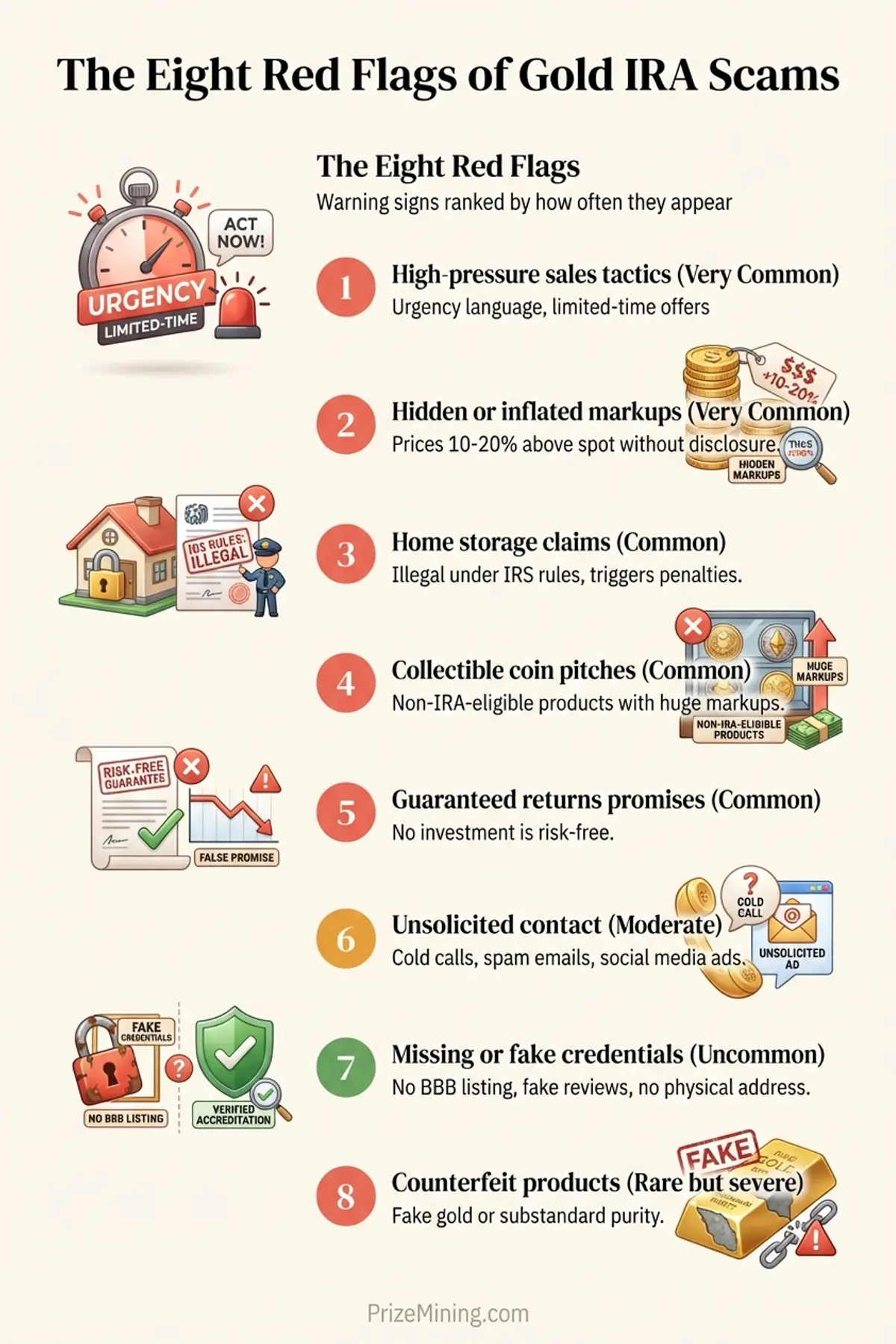
What Are the Eight Red Flags?
We ranked these warning signs by how frequently they appear in regulatory complaints and enforcement actions. The severity rating reflects the level of concern each flag should trigger: yellow means proceed with caution, orange means step back and verify independently, and red means walk away and consider reporting the company.
1. High-Pressure Sales Tactics and Artificial Urgency
“This price is only available today.” “We only have three units left at this premium.” “The market is about to move and you will miss it.” High-pressure tactics are the single most common warning sign in Gold IRA complaints filed with the BBB and state regulators. Legitimate precious metals dealers do not need to manufacture urgency. Gold trades on global markets every business day, and no single dealer controls the supply (Source: CFTC).
If a representative pressures you to make a decision during a single phone call, that pressure itself is the information. A reputable company will give you time to review materials, compare alternatives, and consult an independent advisor.
2. Inflated Dealer Markups
Normal dealer markups on IRA-eligible bullion range from about 3% to 10% above the spot price. In documented fraud cases, markups have reached 100% to 130% above spot, meaning investors paid more than double the market value of the metals they received. The SEC's case against Red Rock Secured is the most prominent recent example. For context on what legitimate markups look like, our Gold IRA fees breakdown covers the typical range across major providers (Source: SEC).
3. Home Storage Claims
Any company claiming you can store IRA metals in a home safe, a personal vault, or a safety deposit box under your own name is either misrepresenting the law or promoting a structure that the IRS has successfully challenged. IRS rules require IRA metals to be held by a qualified custodian at an approved depository. Home storage can trigger immediate taxation, a 10% early withdrawal penalty, and disqualification of the entire account. Our home storage Gold IRA guide explains the legal requirements in detail (Source: IRS).
4. Collectible and Numismatic Coin Pitches
IRS rules specify which metals are eligible for inclusion in an IRA. The list is limited to certain bullion coins and bars meeting minimum fineness standards. Collectible, numismatic, and rare coins are generally not IRA-eligible. Companies that steer you toward high-premium collectible coins may be doing so because the markup on those items is dramatically higher than on standard bullion. A numismatic coin with a 40% premium over melt value generates far more profit for the dealer than a standard American Gold Eagle with a 5% premium (Source: IRS).
5. Guaranteed Returns Promises
Gold does not pay interest or dividends. Its value depends entirely on market demand. No one can guarantee that gold will appreciate in value over any time period. Any claim of “guaranteed returns,” “risk-free growth,” or “certain appreciation” in connection with a Gold IRA is, at minimum, misleading and potentially a violation of securities regulations. Our Gold IRA risks overview covers the real performance history and the factors that affect it (Source: SEC).
6. Unsolicited Contact
Cold calls, unsolicited emails, and social media messages promoting Gold IRA opportunities are a frequent starting point for fraud. An unsolicited Gold IRA call works like a stranger offering you a ride — the convenience masks the risk. Legitimate providers typically do not cold-call prospective customers to pitch specific products. If someone contacts you out of the blue with an urgent Gold IRA opportunity, treat the contact itself as a warning sign. This applies doubly to any solicitation that references your existing retirement account by name or balance, because that information should not be available to outside parties (Source: FTC).
7. Counterfeit or Impure Products
In rare but documented cases, investors have received metals that were counterfeit, below stated purity, or entirely different products from what was ordered. This is outright fraud. Approved depositories typically verify metals upon receipt, which is one reason the custodian-and-depository structure exists. Investors who bypass this structure, whether through home storage or through unregulated dealers, face higher risk of receiving substandard products (Source: CFTC).
8. Unresolved Complaints Pattern
A single complaint does not necessarily indicate fraud. A pattern of unresolved complaints, particularly ones involving delivery delays, undisclosed fees, and difficulty liquidating holdings, signals a systemic problem. Check the BBB complaint history, CFTC enforcement actions, and state attorney general records before committing funds. A company that consistently fails to resolve customer disputes is telling you something about how it operates. Our review methodology explains how we weight complaint history when evaluating providers (Source: BBB).
What Happened in the SEC v. Red Rock Case?
The SEC's enforcement action against Red Rock Secured LLC provides a concrete example of how Gold IRA fraud operates at scale. According to the SEC's complaint, the company and its principals collected approximately $76 million from more than 700 investors, many of them retirees, by selling precious metals at markups of 100% to 130% above the prevailing market price (Source: SEC Litigation Release).
The mechanics were straightforward. Sales representatives used high-pressure telephone campaigns to persuade investors to roll over existing retirement funds into self-directed IRAs. Once the rollover was complete, the representatives steered investors toward specific metals products priced far above market value. Investors believed they were paying a modest premium. Many did not discover the true markup until they attempted to liquidate and received offers at or near the actual spot price, realizing they had lost half their investment to the dealer spread alone.
The Red Rock case illustrates several of the eight red flags operating simultaneously: high-pressure tactics, extreme markups, and a pattern of complaints that accumulated over years before regulators took action. It also demonstrates why independent price verification matters. If an investor had compared the per-ounce price quoted by Red Rock against the spot price published by a commodities exchange, the 100%+ markup would have been immediately visible.
Think of the spot price as a public scoreboard. It tells you what the market says an ounce of gold is worth at this moment. If a dealer is quoting you a price that is double the scoreboard, the gap is not a premium for service. It is the gap between what you are paying and what your metals are actually worth.
How Is Expensive Different from Fraudulent?
One of the most important distinctions in evaluating Gold IRA providers is the line between high fees and actual fraud. These are different problems with different remedies, and confusing them leads investors either to dismiss legitimate concerns or to accuse honest companies of wrongdoing.
High fees mean a company charges more than its competitors for similar services. A dealer markup of 8% when others charge 4% is expensive but not necessarily illegal. The company may be covering advertising costs, paying higher commissions, or simply pricing at what the market will bear. The remedy is comparison shopping and negotiation. Our fee breakdown provides benchmarks for what typical costs look like.
Fraud means a company is deceiving you: lying about the markup, misrepresenting the product, promising returns that are impossible, or concealing material information that would change your decision. The remedy is reporting the company to regulators and, if necessary, pursuing legal action.
The decision framework is simple. If you received accurate information about all costs and chose to proceed, you may have overpaid, but you were not defrauded. If the company concealed, misrepresented, or lied about the costs, the products, or the terms, that is a different category entirely. Understanding this distinction helps you calibrate your response: walk away from expensive providers, report fraudulent ones.
Think of it like hiring a contractor for a home repair. A contractor who charges $200 per hour when others charge $100 is expensive. A contractor who bills you for work that was never done is committing fraud. The first situation calls for a better quote. The second calls for a complaint to the licensing board.
How to Verify a Gold IRA Company
Before sending money to any Gold IRA provider, verify the company through multiple independent sources. No single check is sufficient on its own. The process takes about 30 minutes and can prevent losses of thousands of dollars. Our review methodology describes the full verification process we use when evaluating providers.
- Better Business Bureau (BBB). Search for the company on bbb.org. Check the rating, the number of complaints, and whether complaints have been resolved. Checking a provider's BBB record works like reading restaurant health inspection scores — it won't guarantee a good meal, but it filters out the worst options. Pay close attention to the nature of complaints, not just the count. A company with 50 resolved complaints may be more trustworthy than one with 5 unresolved complaints (Source: BBB).
- SEC EDGAR database. Search for the company name and the names of its principals. Look for enforcement actions, cease-and-desist orders, or litigation releases. The SEC's investor alerts page also flags common self-directed IRA risks (Source: SEC).
- CFTC enforcement actions. The CFTC has jurisdiction over precious metals fraud involving futures and leveraged contracts. Search their enforcement database for the company name (Source: CFTC).
- FINRA BrokerCheck. If any representative claims to be a registered investment advisor or broker, verify their registration through FINRA BrokerCheck. An unregistered person offering investment advice may be operating illegally.
- State regulators. Contact your state's attorney general office or securities regulator. Many states maintain complaint databases and can confirm whether a company is licensed to operate in your state.
- Custodian verification. Confirm that the custodian named by the provider is a real, regulated financial institution. Check that the custodian is approved by the IRS to hold IRA assets. You can verify this independently by contacting the custodian directly.

What Should You Do If You Suspect Fraud?
If you believe you have been the victim of a Gold IRA scam, or if you recognize multiple red flags during the sales process, take these steps. Acting quickly can sometimes limit losses and helps regulators build cases against repeat offenders.
- Preserve all documentation. Save every email, contract, account statement, marketing material, and recording of phone calls (if you are in a one-party consent state). These records are critical for any complaint or legal action.
- File a complaint with the FTC. Report at ReportFraud.ftc.gov. The FTC collects complaints and shares them with law enforcement agencies nationwide (Source: FTC).
- Contact your state attorney general. State attorneys general can investigate and take enforcement action against companies operating in their jurisdiction. Many states have dedicated consumer protection divisions.
- Report to the SEC or CFTC. If the fraud involves securities or commodities, file a tip with the appropriate agency. The SEC's Office of Investor Education and Advocacy accepts tips online. The CFTC accepts complaints through its website.
- File a BBB complaint. While the BBB does not have regulatory authority, a formal complaint creates a public record that other consumers can see and may prompt the company to respond.
- Consult an attorney. For significant losses, an attorney specializing in securities fraud or elder financial abuse can advise on recovery options, including arbitration, class actions, or individual lawsuits.
Do not assume the amount is too small to report. Regulatory agencies build cases by aggregating complaints. Your report may be the one that triggers an investigation protecting hundreds of other investors.
What Mistakes Make You Vulnerable?
Most Gold IRA fraud succeeds not because the schemes are sophisticated but because investors skip basic verification steps under time pressure or emotional influence. Avoiding these mistakes significantly reduces your exposure.
- Deciding on a single phone call. The most effective defense against high-pressure sales tactics is simply refusing to make a decision during the initial contact. Tell the representative you will review the materials and call back. If they resist, that resistance is your answer. A legitimate company will still be there tomorrow.
- Not checking the spot price independently. Before agreeing to purchase any metals, check the current spot price on a commodities exchange or a financial data site. Compare the quoted price per ounce against that benchmark. If the markup exceeds 10%, ask the representative to explain the difference in writing.
- Relying on reviews from a single source. Some companies cultivate positive reviews on one platform while accumulating complaints on others. Check at least three independent sources: the BBB, Google reviews, and a specialized financial review site. Be skeptical of companies that have hundreds of five-star reviews but no negative feedback anywhere, as that pattern can indicate review management (Source: CBS News).
- Skipping custodian verification. The custodian holds your retirement assets. Confirming that the custodian is a real, regulated entity is not optional. Call the custodian directly, verify that they have a relationship with the provider, and confirm that your account exists.
- Ignoring the non-commercial alternative. Before committing to any Gold IRA, consider whether your goals can be met through lower-cost alternatives such as a gold ETF in a standard brokerage IRA, which eliminates custodian fees, storage costs, and dealer markups entirely. A fee-only financial advisor can help you evaluate whether the physical-metal structure is worth the additional cost for your situation. Our Gold IRA how it works guide explains both approaches.
What Should You Check Before Opening an Account?
If you have reviewed the eight red flags and verified a company through independent sources, these final checks can help you make a confident decision.
- Get the full fee schedule in writing. Request a document listing every fee: setup, annual maintenance, storage, dealer markup on specific products, buyback spread, wire transfer fees, and account termination fees. If the company will not provide this, consider it a red flag. Our fee guide explains what each line item should look like.
- Confirm IRA eligibility of the metals. Ask which specific products the company recommends and verify that each one meets IRS fineness standards for IRA inclusion. Be skeptical of any recommendation for collectible or numismatic coins.
- Verify the depository. Confirm the name and location of the depository where your metals will be stored. Approved depositories include facilities like Delaware Depository and Brink's. You should be able to contact the depository independently.
- Understand the liquidation process. Ask how long it takes to sell your metals and receive proceeds, what the buyback spread is, and whether there are any penalties for early liquidation. A clear liquidation process is a sign of a well-run operation.
- Compare at least three providers. The single most effective protection against overpaying or falling for a scam is comparison. When you see the same product priced three different ways, outliers become obvious. Our provider comparison worksheet is built for this purpose.
For a complete overview of how Gold IRAs function, including rollovers, custodian selection, and IRS rules, our Gold IRA resource center ties together every topic we cover. Understanding the legitimate process makes it far easier to spot when someone is deviating from it.
When to Talk to a Financial Advisor
Consider consulting a fee-only financial advisor before proceeding if any of these apply to your situation:
- You suspect a current provider is using deceptive practices
- You have already committed funds and want to verify the arrangement
- You received an unsolicited offer and want independent verification
Next step
Ready to evaluate providers with confidence? Review the fee breakdown to understand what legitimate costs look like, or use our provider comparison worksheet to compare companies side by side before you start shopping.
Gold IRA scams persist because they exploit legitimate concerns about inflation and financial instability. The eight red flags described above, from high-pressure tactics to unresolved complaint patterns, cover the vast majority of documented fraud and misconduct in this space. Recognizing even one of them during a sales interaction should be enough to pause, verify, and seek independent confirmation before committing any retirement funds.
The distinction between expensive and fraudulent matters. Not every company that charges high fees is running a scam, and not every company with a polished website is trustworthy. Independent verification through the BBB, SEC, CFTC, FINRA, and state regulators is the most reliable way to separate legitimate providers from those that put their interests ahead of yours. Thirty minutes of research can protect decades of retirement savings.
James Hartley
Former financial journalist (8 years) · Series 65 license holder
James covers retirement planning and precious metals investing. He spent eight years as a financial journalist before joining PrizeMining to research Gold IRA providers, fee structures, and regulatory requirements.
Sources
- 1.SEC Litigation Release — Red Rock Secured LLCOfficial
- 2.CFTC Press Releases — Precious Metals FraudOfficial
- 3.FINRA BrokerCheckOfficial
- 4.Better Business Bureau — Provider RatingsOfficial
- 5.CBS News — Gold IRA Scams to Watch ForNews
Gold IRA Due Diligence Checklist
10 items to verify before you open an account: fee transparency, custodian credentials, storage terms, buyback policies, and more. Free PDF, straight to your inbox.
No spam. Unsubscribe anytime. We never share your email.
This content is for informational purposes only and does not constitute financial, investment, or tax advice. Gold IRAs carry risks including price volatility, limited liquidity, and fees that can erode returns. Always consult a qualified financial advisor before making retirement investment decisions.