

Self-Directed IRA Basics
A self-directed IRA lets you hold assets most retirement accounts cannot touch. The SEC has issued multiple fraud alerts specifically targeting self-directed IRA investors. More investment freedom means more responsibility for research and compliance. This article covers what you can hold, what is prohibited, and where investors most often get into trouble.
Key Takeaways
- A self-directed IRA follows the same IRS tax rules as a regular IRA; only the custodian and investment options differ.
- Permitted assets include real estate, precious metals, private equity, and more, but collectibles, life insurance, and S-corp stock are prohibited.
- Prohibited transactions with disqualified persons can disqualify your entire IRA and trigger immediate taxes plus penalties.
What Is a Self-Directed IRA?
A self-directed IRA is an individual retirement account held at a custodian that permits a broader range of investments than a standard brokerage. Where a typical IRA at Fidelity or Vanguard limits you to stocks, bonds, ETFs, and mutual funds, a self-directed IRA can hold real estate, precious metals, private placements, promissory notes, tax liens, and other alternative assets (see the IRS retirement plans FAQs).
The term “self-directed” is not an official IRS classification. The IRS does not distinguish between a “regular” IRA and a “self-directed” one. Both are governed by the same section of the tax code: 26 U.S.C. § 408. The label comes from the industry and refers to the fact that the account holder, not the custodian or a financial advisor, makes every investment decision.
Think of it like the difference between a guided bus tour and a rental car. Both get you to the same destinations. The bus tour picks the route, the stops, and the schedule. The rental car lets you go anywhere the roads allow, but you are responsible for navigation, fuel, and not driving off a cliff. A self-directed IRA is the rental car of retirement accounts: maximum flexibility, maximum responsibility.
Self-Directed IRA vs. Regular IRA — Same Tax Rules, Different Menu
The most common misconception about self-directed IRAs is that they are a different type of account with different tax treatment. They are not. A self-directed IRA can be structured as a Traditional IRA (tax-deductible contributions, taxed withdrawals) or a Roth IRA (after-tax contributions, tax-free withdrawals). The contribution limits, required minimum distributions, and early withdrawal penalties are identical (Source: IRS Publication 590-A).
What changes is the custodian and the investment options. A mainstream brokerage custodian restricts you to publicly traded securities because those are easy to value, easy to trade, and easy for the custodian to administer. A self-directed IRA custodian accepts alternative assets because their business model is built around the additional paperwork, record-keeping, and compliance those assets require.
The confusion between “self-directed IRA” and “regular IRA” matters because it leads some investors to believe they are getting a special tax advantage. They are not. What they are getting is a wider range of investments within the same tax wrapper. The tax wrapper is identical. The contents can be very different. Understanding this distinction is critical before you commit, because the tax rules that apply to all IRAs govern your self-directed account in exactly the same way (Source: NerdWallet).
| Feature | Regular IRA (Brokerage) | Self-Directed IRA |
|---|---|---|
| Custodian | Brokerage (Fidelity, Schwab, etc.) | Specialized custodian or trust company |
| Investment options | Stocks, bonds, ETFs, mutual funds | All of the above plus real estate, metals, private equity, notes |
| Contribution limits | Same IRS limits | Same IRS limits |
| Tax treatment | Traditional or Roth | Traditional or Roth |
| Due diligence | Brokerage screens listed securities | Investor is solely responsible |
| Typical fees | $0 – $75/yr | $250 – $500+/yr |
| Liquidity | High (trade in seconds) | Varies (days to months, depending on asset) |
What Can You Hold in a Self-Directed IRA?
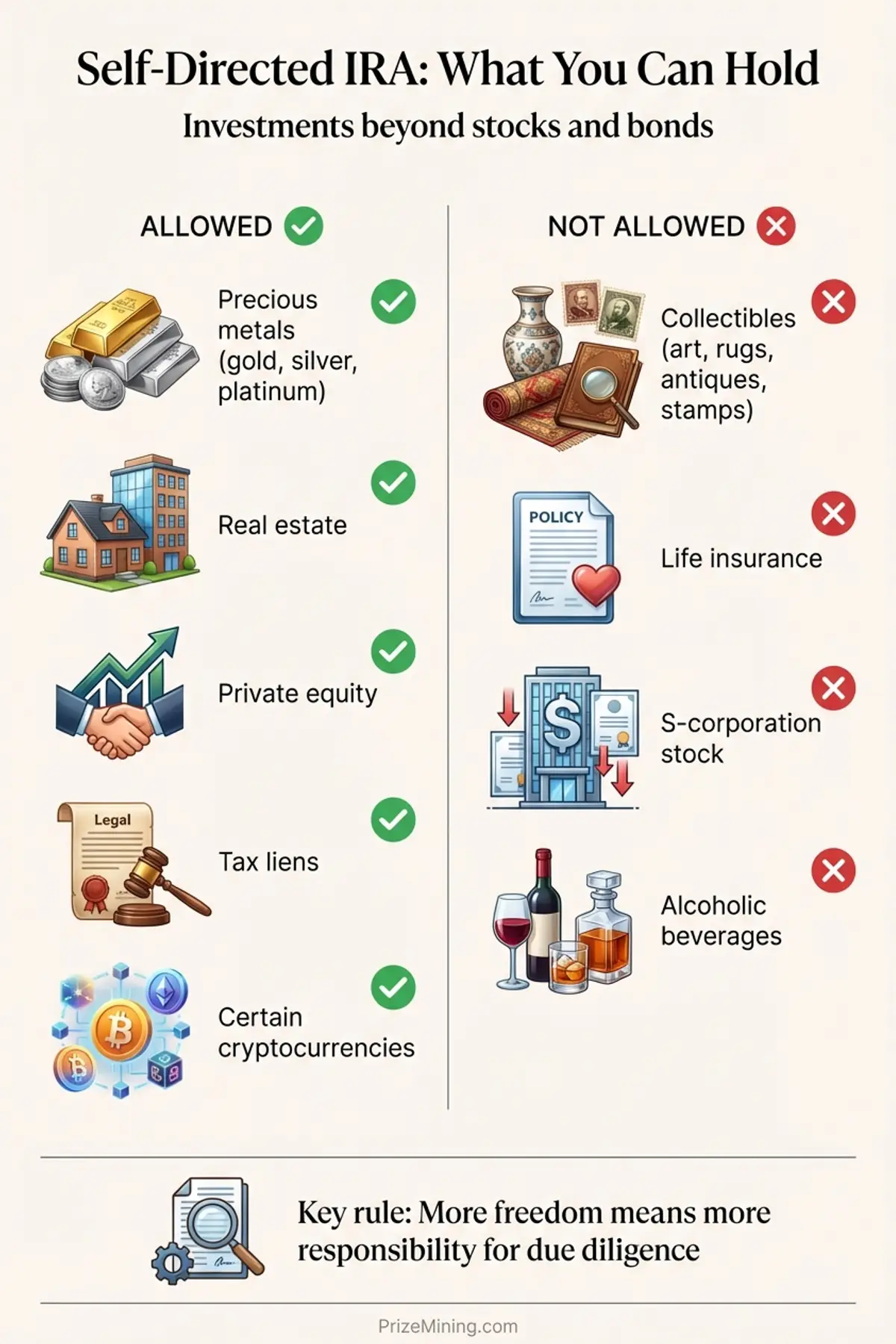
The IRS does not publish a list of “allowed” self-directed IRA investments. Instead, it lists what is prohibited: life insurance contracts and most collectibles (artwork, rugs, antiques, gems, stamps, alcoholic beverages). Everything not on the prohibited list is technically permitted, though individual custodians may further restrict what they accept (Source: IRS Retirement Plans FAQs).
Precious metals get a specific carve-out. While collectible coins are generally prohibited, IRS-approved gold, silver, platinum, and palladium coins and bars that meet minimum fineness requirements are allowed. This is the legal basis that makes Gold IRAs possible.
| Asset Category | Examples | Key Consideration |
|---|---|---|
| Real estate | Rental properties, raw land, commercial buildings | All expenses and income must flow through the IRA |
| Precious metals | IRS-approved gold, silver, platinum, palladium | Must meet fineness standards; must be held by an approved depository |
| Private equity | LLC interests, startup shares, private placements | Illiquid; hard to value; high fraud risk |
| Promissory notes | Private lending, mortgage notes | Borrower default risk; no FDIC protection |
| Tax liens / deeds | Municipal tax lien certificates | Complex redemption rules; varies by state |
| Cryptocurrency | Bitcoin, Ethereum (via some custodians) | Extreme volatility; custodian support varies |
Not permitted: collectibles (art, rugs, antiques, gems, stamps, alcoholic beverages), life insurance contracts, S-corporation stock.
The breadth of options is appealing, but breadth without expertise is dangerous. Imagine a hardware store that sells both hammers and dynamite. Both are tools. One requires significantly more training to use safely. The alternative assets in a self-directed IRA are the dynamite: powerful, but capable of causing serious damage if handled incorrectly (Source: SEC Investor Alert).
Prohibited Transactions — The Lines You Cannot Cross
The IRS imposes strict rules about who your IRA can do business with. These are called prohibited transactions, and violating them can disqualify your entire IRA. A disqualified IRA is treated as if you withdrew all the funds on the first day of the year the violation occurred, triggering income taxes on the full balance plus a 10% early withdrawal penalty if you are under 59½ (Source: IRS Retirement Plans FAQs).
The rules center on “disqualified persons,” a category that includes you, your spouse, your parents, your children, their spouses, and any entity where you or these family members own 50% or more. Your IRA cannot buy from, sell to, lend to, borrow from, or provide services to any disqualified person.
- You cannot live in or vacation at property your IRA owns. If your self-directed IRA buys a rental house, you cannot stay in it, not even for one night. Your children cannot live there. Your parents cannot rent it at a discount.
- You cannot perform work on IRA-owned property yourself. If the rental house needs a new roof, your IRA must hire a third-party contractor. You cannot do the work yourself, even for free. Personal labor counts as a prohibited transaction because it provides a benefit to the IRA from a disqualified person.
- You cannot lend IRA funds to yourself or family members. Your IRA cannot loan money to your business, co-sign on your mortgage, or pay your personal expenses.
- You cannot use IRA assets as collateral. Pledging IRA-held real estate as security for a personal loan is a prohibited transaction.
Think of the prohibited transaction rules like the walls in a hospital between a surgeon and their own family member’s operation. The surgeon may be fully qualified, but the personal connection creates conflicts that the rules exist to prevent. In a self-directed IRA, the conflict is between your personal financial interests and the retirement account’s tax-advantaged status.
The home storage IRA debate is a direct example of how prohibited transaction rules affect real investors. Storing IRA-owned precious metals at home raises serious prohibited transaction concerns, which is why the IRS requires metals to be held by an approved depository.
What Does the Custodian Do?
Every IRA must have a custodian. For a self-directed IRA, the custodian is typically a trust company or specialized financial institution that handles the administrative, reporting, and compliance work. What catches many investors off guard is what the custodian does not do (Source: SEC Investor Alert).
A self-directed IRA custodian holds the assets, processes transactions you direct, files IRS reports, and issues required statements. Think of the custodian as a mailroom — they sort and deliver packages but never inspect what is inside. That is where their responsibility ends. They do not evaluate the quality of your investments. They do not verify that a real estate deal is fairly priced. They do not check whether a private placement is legitimate. They do not warn you if you are about to make a bad investment.
The SEC has specifically warned investors not to confuse custodial oversight with investment due diligence. In their 2024 investor alert, the SEC stated that “self-directed IRA custodians generally do not evaluate the quality or legitimacy of any investment in the self-directed IRA or its promoters.” A custodian holding a fraudulent investment does not make that investment legitimate.
This is one of the clearest examples of what we call The Freedom-Responsibility Trade-Off. A regular IRA at a brokerage benefits from layers of screening: the brokerage vets listed securities, SEC filings provide transparency, and market pricing gives you real-time valuations. A self-directed IRA strips away those guardrails. You gain the freedom to invest in anything, but you inherit full responsibility for every aspect of due diligence. More investment options means more responsibility for research, valuation, and fraud detection.
When evaluating custodians, look for state or federal regulatory oversight, published fee schedules, a track record of at least five years, and clear documentation of what they will and will not do. Our overview of how a Gold IRA works walks through the custodian selection process in the context of precious metals accounts.
What Are the Risks and Responsibilities?
The SEC, FINRA, and state securities regulators have all issued warnings about self-directed IRA fraud. The core problem is structural: alternative assets are harder to value, harder to sell, and easier to misrepresent than publicly traded securities. That combination creates fertile ground for fraud, and the self-directed IRA structure does not provide the protective layers that a brokerage IRA does (Source: SEC Investor Alert).
- Fraud exposure. The SEC reports that self-directed IRAs are frequently targeted by promoters of fraudulent investments. Because the custodian does not vet investments, a fraudulent offering can sit inside a legitimate IRA structure, giving it false credibility. The custodian’s name on the statement does not validate the underlying investment.
- Illiquidity. Selling an alternative asset from a self-directed IRA is like selling a house in a small town — the buyer pool is limited and the timeline is unpredictable. Real estate, private equity, and many alternative assets cannot be sold quickly. If you need to take a required minimum distribution and your IRA holds a single rental property, you may need to sell the property or find another source of funds. Illiquidity creates distribution problems that stocks and bonds do not.
- Valuation difficulty. Publicly traded securities have a market price updated every second. A rental property, a private company stake, or a promissory note does not. You may need an independent appraisal, which costs money and may still be disputed. Inaccurate valuations can lead to incorrect tax reporting (Source: The Motley Fool).
- Inadvertent prohibited transactions. The prohibited transaction rules are complex enough that investors sometimes violate them without realizing it. A property owner who mows the lawn of an IRA-owned rental has committed a prohibited transaction. The consequences, disqualification of the entire IRA, are disproportionate to the act.
- Higher fees. Self-directed IRA custodians charge more than brokerage custodians because alternative assets require more administrative work. Annual fees of $250 to $500 are common, and transaction fees, wire fees, and asset-specific charges add up. These costs are in addition to any fees charged by the investments themselves.
For a deeper look at how these risks apply specifically to precious metals accounts, our Gold IRA risks overview covers the SEC warnings, liquidity concerns, and fee impacts that affect gold and silver investors (Source: NerdWallet).

When a Self-Directed IRA Is Not the Right Choice
A self-directed IRA offers flexibility that most retirement accounts cannot match, but that flexibility is not valuable for every investor. Before opening one, consider whether any of these situations apply to you.
- You prefer hands-off investing and do not want to research individual assets. A self-directed IRA puts every investment decision on your shoulders. There is no fund manager selecting assets, no brokerage screening listings, and no automatic rebalancing. If you want a retirement account that runs on autopilot, a regular IRA with target-date funds or index funds is a simpler and less risky option.
- You lack experience evaluating alternative investments. Real estate, precious metals, private equity, and promissory notes each require specialized knowledge to evaluate. Buying a rental property through an IRA is not the same as buying a mutual fund. If you do not have experience with the asset class you plan to hold, the learning curve can be expensive.
- You want the lowest possible fees. A regular IRA at a major brokerage costs $0 to $75 per year with access to index funds charging 0.03% or less. A self-directed IRA custodian typically charges $250 to $500 annually before transaction fees. If keeping costs minimal is your priority, a self-directed structure adds expense without necessarily adding value.
- You are uncomfortable with the prohibited transaction rules and the risk of accidentally disqualifying your account. The prohibited transaction rules are strict, counterintuitive, and carry severe consequences. A single misstep, such as performing maintenance on IRA-owned property, can cause the IRS to treat your entire account as distributed. If navigating those rules feels like more risk than you want to carry, a standard IRA eliminates that exposure entirely.
Talk to a fee-only financial advisor before opening a self-directed IRA. An independent professional can assess whether the added flexibility justifies the added complexity and cost for your specific situation.
How Self-Directed IRAs Connect to Gold IRAs
A Gold IRA is a specific type of self-directed IRA. This works like a specialty shop within a department store — the store rules apply to every shop, but the inventory and expertise are narrower. Everything discussed on this page, the tax rules, the prohibited transactions, the custodian structure, the due diligence responsibility, applies to Gold IRAs in full. The only difference is that a Gold IRA narrows the investment focus to IRS-approved precious metals held at a qualified depository.
If you arrived here while researching precious metals retirement accounts, the self-directed IRA framework is the foundation. Understanding how the custodian works, where the prohibited transaction lines are, and what the custodian does not do for you prepares you to evaluate Gold IRA providers with clearer eyes. A provider that glosses over these structural realities is not giving you the full picture.
Our Gold IRA how-it-works overview picks up where this page leaves off, explaining the step-by-step process of opening an account, funding it, selecting metals, and arranging storage. The retirement planning hub connects all of our articles on IRAs, 401(k) rollovers, and tax-advantaged retirement strategies.
Next step
Ready to explore precious metals in a self-directed IRA? Learn how a Gold IRA works step by step, or review the risks before committing.
A self-directed IRA gives you access to investments that most retirement accounts cannot hold. That access comes with a trade-off: the broader your investment options, the more responsibility falls on you to evaluate quality, verify legitimacy, and avoid prohibited transactions. The custodian administers the account but does not protect you from bad investments. The IRS provides the tax wrapper but will disqualify the account if you break the rules.
The Freedom-Responsibility Trade-Off is not a reason to avoid self-directed IRAs. It is a reason to enter them with your eyes open. Understand the prohibited transaction rules before you invest. Verify the custodian’s regulatory status. Get independent valuations for any alternative asset. And if you are considering precious metals specifically, the Gold IRA resource center connects our full library of articles, from tax rules to risk factors to provider comparisons.
James Hartley
Former financial journalist (8 years) · Series 65 license holder
James covers retirement planning and precious metals investing. He spent eight years as a financial journalist before joining PrizeMining to research Gold IRA providers, fee structures, and regulatory requirements.
Sources
Gold IRA Due Diligence Checklist
10 items to verify before you open an account: fee transparency, custodian credentials, storage terms, buyback policies, and more. Free PDF, straight to your inbox.
No spam. Unsubscribe anytime. We never share your email.
This content is for informational purposes only and does not constitute financial, investment, or tax advice. Gold IRAs carry risks including price volatility, limited liquidity, and fees that can erode returns. Always consult a qualified financial advisor before making retirement investment decisions.